Tuesday, 2 July 2019

The Case for Teaching Sex Ed to a Mixed Group

Sex education is one of those topics that really tends to divide people. Many people, myself included, have strong feelings about what, when and how it should be taught. In some circles, the word "if" might even appear on that list.

As a society, we can see the discomfort with the topic through the many euphemisms we use for sex ed. (and sex in general, but that list would be longer than anyone might care to read!)-- from "human growth and development" to "family life", and everything in between. Sometimes these cause confusion, like the time I was in elementary school and I heard we were going to study "family life". I thought it would be about things like road trips and camping vacations.

The sad truth is, society has some big hangups when it comes to discussing sex and sex education, and students are all too aware of this.

Whatever our religious, cultural and political leanings, most Canadians can agree that it is a good idea to give kids some sort of "heads-up" about changes coming in puberty and how these affect human reproduction.

The old-school way was to separate out the boys and girls and give them the information they needed in a lecture followed by a question and answer session. Sometimes there would be a question box for students who were uncomfortable asking in person. The rationale was that students were more comfortable talking about these things with students of their own gender, and that they each needed different information.

And herein lies the problem.

This practice makes some assumptions that can hurt students.

First of all, I will argue that it is very important and relevant for students to understand the changes that everyone goes through in adolescence, not just themselves. By learning about others. students are much more likely to develop empathy with others. They are better equipped to understand other family members, friends and partners, and to become better parents as they have a greater understanding of the human reproduction portions of sex education.

Second of all, dividing the class in this way displays an assumption of the gender binary, and also of adherence to assigned gender for any trans or non-binary students who might not yet be "out". The intention of creating a safe environment to ask questions and share information does quite the opposite for such students. This can also be devastating for students who are questioning their gender identity.

If we are serious about creating safe, caring and inclusive schools that celebrate diversity and welcome everyone, we need to rethink the way we have traditionally gone about teaching sex education in particular, but also in all of the ways in which we assume gender binary by dividing students into boy and girl teams, lines in the hall, and so on from kindergarten or even earlier. In an era in which the topic of gender is as divisive as ever, we need to take care in our choices with the newest generation.

So how do we encourage students to ask questions and seek clarification?

Some things we can do to help create a safe environment for everyone:

- encourage students to share their feelings about sex and sex ed. with the group, allowing for students to contribute anonymously
- collaborate with the group to set up a list of behaviour expectations for group discussion
- encourage all students to ask questions, and make an effort to answer all the questions as accurately as possible (allow yourself time to consult with health professionals as needed)

Some ways to allow for anonymity:

- distribute 1-2 cards or sticky notes per student and instruct them to write their questions on these; students without questions can write "hello" or similar instead; collect all notes so that no one student stands out as having had a question
- have a question box students can add their questions to anonymously
- set up a Google Form with a short-answer option and turn off the "show email" option


Friday, 31 May 2019

Improving Student AND Teacher Engagement

Today is report card writing day. I am one of those teachers who generally hates marking. I try and give mark-free feedback along the way as much as possible to keep students working on improving rather than obsessing about marks. But when it comes to report cards, a mark must be given, along with supporting evidence.

In my recent LTO positions, the "regular" teacher has left me more "traditional" units which overlap with their time in the class. I have also had some planning time LTO work where I rotate from class to class for 30 minute blocks of time, which has made more hands-on projects very challenging in terms of storage as well as set-up and take-down. This has left me with less freedom to do hands-on activities.

I really believe in the idea that we learn best by doing, by trying things out, by making mistakes and learning how to adjust and problem solve our way through a challenge.

This spring I have focused on making much of the learning hands-on. For science, the students created their own building companies. They created a name and logo for their companies. They had to apply their math to create and follow a budget for supplies and to draw out accurate building plans. They had to apply their understanding of internal and external forces. They had to determine and delegate smaller jobs to bring their project together, and so on. I incorporated building and safety permits, fines for noise and safety violations...you get the picture.

For language, they created and filmed book trailers or highly detailed book posters. For social studies, they took on roles throughout the study of first contact, and are working on building either a Fakebook profile or news article about a specific person or topic.

What I'm finding is that the more hands-on the activity, is, the more the students are engaged. They enjoy sharing their work and take a greater pride in sharing it than any more traditional paper-and-pencil tasks. This was not a surprise to me. What was a pleasant surprise is that the marking is becoming much more enjoyable to me as well.

My tea is nearly ready as I sit back and watch a second batch of book trailers. Netflix has nothing on my students in 5A!

Sunday, 3 February 2019

The Importance of Prior Knowledge


The Blue Walloo


Over the next few days, we will explore the controversy regarding allocating additional funding to The Blue Walloo. Stakeholders supporting the move have expressed concerns that failure to do so will provide incentive to further defund similar programs. Those opposed state that such funding sets precedents that are difficult, if not impossible, to maintain.

Please state and defend your position regarding the funding of The Blue Walloo. You must include supporting evidence and a concise conclusion.


What is wrong with this exercise?


Do you know what The Blue Walloo is? Did you make a guess--and if so, what did you guess?

It could be a night club, an oceanographic exploration, an endangered bird, a novel, a painting, a secret service operation, a cultural event…

What if I gave you the following words to define--would this make the exercise accessible?

blue
controversy
funding
precedents
stakeholders
opponents
concerns
walloo
allocating
programs

Now, try substituting the phrase “The Blue Walloo” with one of the following:

Brexit
Polar bears
The Children’s Festival
The Food Bank
The Museum
The Norther Gateway Pipeline
OK2BME
Foreign Aid to Nigeria
The Humane Society
Municipal snow removal
The Heritage Front
House of Friendship Shelter
ION LRT
International Space Exploration
Arms trade with Columbia
Reception House
The Public Library
Employment Insurance
Medical research
Local hockey team
Local Symphony Orchestra
Safe Injection Site
Automotive Industry
Cyber surveillance


Now try a different one of those. How does the meaning change?

How can we use this exercise to inform our approach to teaching students what they need to know  when learning and improving their reading comprehension?

If you are from outside of southwestern Ontario, you may have found some of the last examples equally mystifying as “The Blue Walloo”.

Students come to us with a wide variety of prior experiences. We have students who have lived in different countries, and different cultures within our own country. Some students are learning English as an additional language. The diversity in cultural and socio-economic backgrounds means that the prior knowledge and vocabulary they understand cannot be assumed. We need to actively build those into our teaching so that there is an accessible context from which students can reflect, build connections, make predictions and evaluate the validity of statements.

Cross-Curricular Considerations


This applies not only to language as a distinct subject area, but all academic areas. Relevant vocabulary needs to be introduced and prior knowledge developed in order to ensure that students are able to access the subject matter.

For example, word problems in math need to use examples that students can understand and relate with. One way of ensuring this is to enlist students to create and share their own word problems.

For content areas such as social studies and science, sharing introductory materials in a variety of reading levels for students to access, keeping an active glossary that is built upon as a class, and reviewing, summarizing and sharing in small and large groups collaboratively can help to provide the necessary prerequisites for content fluency. There are many great sites that can be used to this end, just a few of which include:

National Geographic Kids
Brittanica School Online
PebbleGo
Capstone Interactive Library
Newsela
CNN10
Culturegrams
Kids Info Bits (Gale)
Epic Books
BookFlix
Can Points of View

This is not by any stretch an exhaustive list, but should help provide a starting point. If you teach or attend school in Ontario, the Library Learning Commons site will have links to most of the above resources.


Friday, 22 September 2017

Forensic Fridays

Fantastic professional development leads to fantastic ideas. Last spring at Thames Valley STEAM conference,  I was inspired by Jen Brown's talk about Mistakes Monday, wherein students are given a problem with an incorrect solution, and are asked to work in groups to prove why this solution and the reasoning behind it are wrong.

This summer, at the CEMC Math Teacher's Conference, Michael Jacob's talk, Mind the Gaps, was also very enlightening. He showed us incorrect answers, and had us work out how students came about those answers to determine the misconceptions behind those answers. It was enlightening to take the time to discern where seemingly random answers had a basis in logical, if faulty, reasoning.

The idea that it is OK and expected to make mistakes, and that doing so can be beneficial in the learning process, is reflected in the growth mindset work of Carol Dweck and the mathematical mindset work of Jo Boaler. When students never or rarely make mistakes, it may also mean that they are not being appropriately challenged.

And I thought, why not combine these ideas, and create "Forensic Fridays".

Using one or more of the following sources: incorrect student work or correct student work that uses a unique approach (either one that will work consistently, or one in which the answer is coincidentally the same but the strategy is faulty), old EQAO test examples, and CEMC math contests, I search for problems that match misconceptions associated with underlying concepts of the math we are doing in class.

On Friday, students work in pairs or small groups on the question I have posted. They must determine several things:
- is the answer correct?
- how did the person go about solving this?
- what was their train of thought for each step?
- what (if anything) is faulty about their reasoning?
- how can I prove this is correct/incorrect?

Then they must solve the problem correctly in a way that shows their strategy. As students get more comfortable, we will begin to discuss what constitutes a mathematical proof and how to use this to support their thinking.

As a class, we can create a flow chart to demonstrate how to go about these tasks together, in order to break it down for those who struggle with "just knowing" that something is right or wrong, as well as for those who might need extra support.

Since I do not currently have my own class, I have not had the opportunity to try this out. I'd love to hear your feedback if you have done something like this in your classroom.

Saturday, 16 September 2017

Prioritizing Purpose

How many times do we here the words, "When will I ever use this?" in math class? In the media? Every couple of years, there is an editorial in a major newspaper questioning the relevance of teaching students algebra, and questions about whether or not it is necessary for all students to learn.

Math teachers often lament hearing their students ask this very question. We can reply with general, well-meaning answers including statements that it helps build problem solving skills, good work habits, the ability to follow procedures, and the ability to think logically. I've seen lists of careers that depend on higher math (most of which will be sadly outdated by the time students graduate), or a chart of expected income based on the level of math successfully completed. But few actually answer these questions specifically, head-on. I often find myself wondering why this questions persists, and also, why so many of us dread it and skirt the issue.

When I took math in high school, the purpose of most of what we worked on was a complete mystery. However, I did not feel free to ask questions such as "How do we know this?", "How is this used?" and "Who discovered this, and why?", for fear of being considered rude and disrespectful. The answers would have meant a great deal to me as a student. It might have given me reason to finish the pages of textbook-based problems assigned each night on a more regular basis. I also wonder if this lack of connection might not lie at the root of our society's math phobia problems. When learning happens in isolation without the benefit of connecting to relevant applications, it becomes by default a mystery, much like an untranslated ancient language.

Luckily, the Rosetta Stone for math exists through simple internet searching. Math appreciation through learning about how, where, why and by whom the concepts were developed and learning about abstract and concrete connections of concepts and applications are all readily available.

Math teaching has changed somewhat since then, but there is still a tendency toward abstraction without explanation and connection as students move into more complex math, and this, I believe, is one area in which math instruction can and must improve. While it is true that there is a great deal of material to "cover" in the higher grades, what purpose is there to this if students fail to see the relevance and drop or fail out of it, or simply go through the motions of applying algorithms without seeing the purpose and beauty within?

There are countless YouTube resources about the history and demonstration of various math concepts and applications. There are also wonderful apps and online manipulatives such as Gizmos and the line-graph intuition app by Sal Khan that help students visualize and make those connections. As teachers, we need to use these tools not only in the lower grades, but through middle school and beyond. For quirky takes on concepts, there is ViHart.

But why not ask the students to work across the curriculum and discover those answers for themselves? They could create a historical video, a comic strip, a simple paper, a song/parody, booklet, interpretive dance (like the trigonometric functions dances and circle dances that already exist), etc. around the history and use of a given mathematician or concept. Yes, this will take time from "covering the material" in class, but taking a period or two to do this just might improve student engagement and investment over the long term.

Resources:
Videos:
It's OK To Be Smart
Standup Maths (Matt Parker)
Numberphile
TedEd (also search this channel for "math" for a more specific playlist)
ViHart

Representation:
Hidden Figures
The ADA Project (also see this NPR article)
Multicultural Mathematics

General Math History:
History of Maths
The Story of Maths

Apps and other resources:
Gizmos
National Library of Virtual Manipulatives
YouCubed
Solve Me Mobile Puzzles

Monday, 11 September 2017

Here We Go Again...

Image result for math classroom canada

Every couple of years we see a huge public outcry about how we need to "go back to basics". Sometimes this is in response to test scores being "below average". Here I will (once again) weigh in on this.

Because most people have spent years in classrooms, they feel like they are qualified to weigh in on educational policy. They appeal to politicians who are not likely to have a background in education or psychology. However, the fact that Canadians are concerned about and value education is something that we can definitely be proud about.

Several news agencies have recently published articles calling for a "back to basics" approach to mathematical education. But what exactly are "the basics"? Are we speaking of numeracy, or simply a fluency with basic number facts?

Many opinion pieces cite methods such as Dewey's constructivism used in the current approaches. What is actually being taught in teacher education is inquiry learning, which shares some features with constructivism, but is not entirely the same thing.

Image result for math classroom
An inquiry model does not require a student to "construct" their understanding of a concept and then leave it at that. The basic lesson has three parts: a minds-on section in which a problem that builds upon prior knowledge is introduced and students are asked to think about how they would go about solving it; an action section in which students collaborate and share their ideas, applying them to a new problem or problem set that extends the concept, with the same concept; and then a consolidation phase in which students share their work. Various approaches used by the students and introduced by the teacher as needed are compared and evaluated for clarity, consistency and efficiency. This phase is where the students consolidate their learning. Students are often asked to complete a new problem or problems using the concept as an "exit ticket" to show their understanding. The teacher uses these to determine the next steps needed for the class, as well as individual students, in order to further their learning.

In subsequent lessons, students are also asked to apply their mathematical understanding in various hands-on ways, which might include projects built in maker spaces, coding, or geometric art.

Taking a lesson to look at mistakes every now and then is also common. Students are asked to look at a teacher-chosen problem and solution, and demonstrate why the reasoning used is not correct. The ideas are that in learning from mistakes, students realize that making mistakes along the way is part of the process, and it also encourages them to work on their own mathematical reasoning skills and means of communicating their mathematical thinking.

What is missing from this approach? Memorization of an algorithm and repeated practice. Memorization of an algorithm provided by the teacher, with detailed steps on how to complete the algorithm, is what many adults equate to math instruction. It is what is familiar to them, since many learned it this way. However, simply knowing the times tables and how to do long division alone do not make a person numerate, any more than knowing the alphabet and phonetic sounds makes someone literate. Maybe you can sound out a simple word, but to gain meaning from the text requires comprehension skills. This is also true of math.


It is true that memorization of times tables helps with the quick completion of worksheets in higher grades. Computation abilities are still important. Even though we have tools everywhere that can complete this with greater speed and efficiency than people can, being able to process these smaller steps with ease and fluency frees up working memory needed to manipulate more complex problems. However, we do have computational tools (calculators, electronic devices, computers), so placing our priorities on those computational skills alone is not beneficial and does a disservice to our students. We need students who are able to apply those concepts, program the computers, choose a strategy, solve problems, make connections, find patterns and apply and extend those patterns, plan and strategize. We need to prioritize higher-order thinking skills that allow us to move beyond basic computation. Students need to develop a sense of number, quantity, additive and multiplicative reasoning, proportional reasoning, patterning, balance, spatial reasoning, estimation skills and so on.

To remain stuck at memorization of number facts and algorithms alone is simply not enough.

Practice is one area that in my opinion could use more balance. We have gone from reams of worksheets, usually all of a single problem type that does not require reflective thought, to the use of 1-3 problems in a day to illustrate a concept. Somewhere in the middle is a place where students have a chance to work on problems that reinforce a concept while being required think critically and strategize, not only with the algorithm of the day, or by matching a pre-determined vocabulary list with a given operation, but in visualizing and manipulating the information given until they make sense of it, then applying an appropriate strategy and computation for solving it. Students need to also be encouraged to search for and find the answers to the age old question, "(when) will we ever use this?". If they don't see a purpose in it, how can we expect them to find the motivation to struggle through a problem or concept? The purpose must be clear.

Another recent push in education is the concept of developing a Growth Mindset, as described by the work of Carol Dweck, and elaborated upon by Jo Boaler. The ideas here are that students need to be open to learning, and accept that there will be some struggle when they are truly learning, but that they are capable of working through this struggle to gain competency. This is especially important in math, since there are many myths that abound about people having a "math brain" or not having one, which is simply not how brains work. While we'd never shrug off being illiterate, common phrases and ideas such as "I'm not a math person" and "you must be so smart to understand math" show how our society reflects an idea that numeracy is out of reach for many people. If students are to learn math, they need to first believe that they can learn it, and the adults around them need to also believe they can.

Thursday, 9 March 2017

Cuisenaire Rods for Intermediate Math

One of the larger goals of math in the intermediate grades is to learn about proportional reasoning (multiplicative thinking) as applied to fractions, percentages, proportions, ratios and patterning. This provides a solid foundation from which higher levels of mathematics can be explored, including geometry, linear and quadratic functions, and data management.

In the primary and junior grades, among other mathematical constructs, students work with decomposing larger numbers into smaller quantities, primarily as addends, and eventually working towards factors as used in multiplication.

Cuisenaire rods are a useful tool in math, allowing students to easily compose and decompose small quantities while showing the proportional relationships. For example,

Image result for cuisenaire rods

Each block can represent an even proportion of units. For example, if we call the white rod "1" and the red rod "2", then it follows that light green is "3" and so on up to 10.

We can combine rods to create larger numbers, such as 12 by using red and orange, 20 by using 2 oranges etc.

We can also assign a larger value than "1" as our base (white) unit. If we assign it as "5", then we can count by 5's up to 50 without the need to add additional rods.

Using these relationships, intermediate students can use these rods to explore the concepts of proportion, ratios, fractions, and the distributive property.

Factoring and the Distributive Property With Cuisenaire Rods

Using the principles listed above, students can use the rods to factor a larger number. For example,
in the following photo, 12 is factored in a variety of ways:


 In the dark green row, we see 2 rods of 6 or 2 x 6. Likewise, in the red row, we see the reversed version where there are 6 rods of 2, or 6 x 2. Through the use of many examples, students can determine through exploration the commutative property of multiplication, and also the relationship between multiplication and division.

Factor trees can also be built in this way, by further reducing the larger factors. Eventually, each component of each row can be factored down to the prime number components.

If we decided to use a base unit other than one, we could compare similar numbers based on proportional relationships. For example, if we chose "3" as our base for the above example, the top row would be worth 36. The second row would be 2 rods of 18. The third row would be 3 rods of 12, and so on. We could also build the 36 by using more orange and red rods and keeping the base unit as 1.

In the following picture, "9" has been divided into various rows in a somewhat different way:

Moving down from the top, the second row shows 3 rods of 3, or 3 x 3. In the third row down, we see something new. Suddenly there are two different colours in the row. Can we write a multiplication expression for this row?
Similarly, the 4th row also has two different colours.
In the 5th row, however, we see a pattern emerge. There are 3 instances of red-white, or 2, 1 in this row. How might we express this mathematically?

This is an example of the distributive principle of multiplication. How else might we use cuisenaire rods to show this?

So far we've been looking at rows of rods to compare relative values. How might we move into an extra dimension where we can compare both rows and columns?

Eventually, algebra tiles will help with these visualizations, however, the challenge of combining grids to visualize proportions allows for concrete abstraction that will eventually lead into linear and quadratic applications.

Tuesday, 22 November 2016

Why I Will Not Teach Tolerance

Coco0612, Educ 323, CC BY-SA 4.0
We've all heard much over the past several weeks about "political correctness". Quite frankly, I suspect all of us have grown tired of that phrase.

I cringe when I hear that phrase, as well as its close relative, tolerance, particularly when they are touted as societal ideals. I believe we can do much better. I believe we must do better if we are to create and maintain a safe, inclusive and globally aware community of learners.

To me, political correctness is much like putting on a mask and pretending not to hold stereotyped prejudices (or downright bigotry), or that it's OK to not learn more about the differences of others. To be fair here, sometimes it might be a matter of time and exposure--perhaps there just hasn't been a chance to do better; particularly for an individual who has never met a person with said difference. However, much can be said about the attitude with which people approach those with differences. In most cases, I believe that being politically correct simply allows people to use the benefits of someone who is different than them without showing them respect beyond the very basic etiquette required of public or business dealings. It is like covering one's eyes and waiting for something undesirable to go away--there is a part of you who knows it exists, but you really wish it would just go away or be done with so you can get on to more interesting or important things. I believe this sort of thought pattern is dangerous, and can lead to the phenomenon we see in which white people fail to see racism as a problem in North America (yes, Canada, we too have a racism problem, and it involves our indigenous people as well as other visible minorities). If political correctness were represented as such in books and movies, it would involve tokenism and stereotypes, with all of the main roles being taken by the dominant group.

One step better than political correctness is tolerance, in which people agree to ignore or overlook differences in order to get by when they must interact. It might contain an inner message such as "I like you despite this one part of your identity". It doesn't necessarily imply that someone is using the other for their own benefit, but it also requires no more than the basic recognition that there are differences in race, religion, socio-economic factors, politics, gender identity, gender expression, sexuality, sexual orientation, age, etc. It requires no discourse, conversation or understanding beyond what is immediate to the circumstances of necessary interaction. If tolerance were to be represented as books and movies, there would be some effort made for representation of a variety of groups, but those would usually play minor roles with the main roles being taken by the dominant group. Some stereotypes would remain.

Rather than promote the above superficial methods of dealing with people who are different in some way, my goal as a parent and teacher is to promote dialogue leading to understanding, acceptance and compassion. I will never be an Hispanic man. I will never be an Inuit child. I will never be a Syrian refugee. I will never be a black transgender woman. I will never fully grasp the experiences of those who are. But I can listen, learn and, albeit to a limited degree, empathize with the experiences and perspectives of those who are, and I can teach my children and my students to do the same. This doesn't mean that we have to believe what others believe, or follow their cultural traditions, or in any other way emulate them; it simply means that we need to look a little closer with our eyes, our ears, our brains and our hearts to better understand their world view. By connecting as humans with others and sharing a larger group membership, be it as a classroom, a local community or a national identity, we all become richer, stronger, and learn to understand and communicate effectively for the benefit of all. If understanding, acceptance and compassion were represented as books and movies, there would be a rich mosaic of representation, with individual characterization and situation replacing any stereotypes.

Some related thoughts on this topic are well articulated in the Ted Talk, "The Danger of a Single Story" by Chimamanda Adichie:  https://www.ted.com/talks/chimamanda_adichie_the_danger_of_a_single_story

Since this is a particularly volatile topic at the present moment, I will not be allowing comments on this particular post. Yes, I do see some irony in that decision, but I will stand by it nonetheless.


Sunday, 25 September 2016

Bees and Wasps: Can You Tell the Difference?

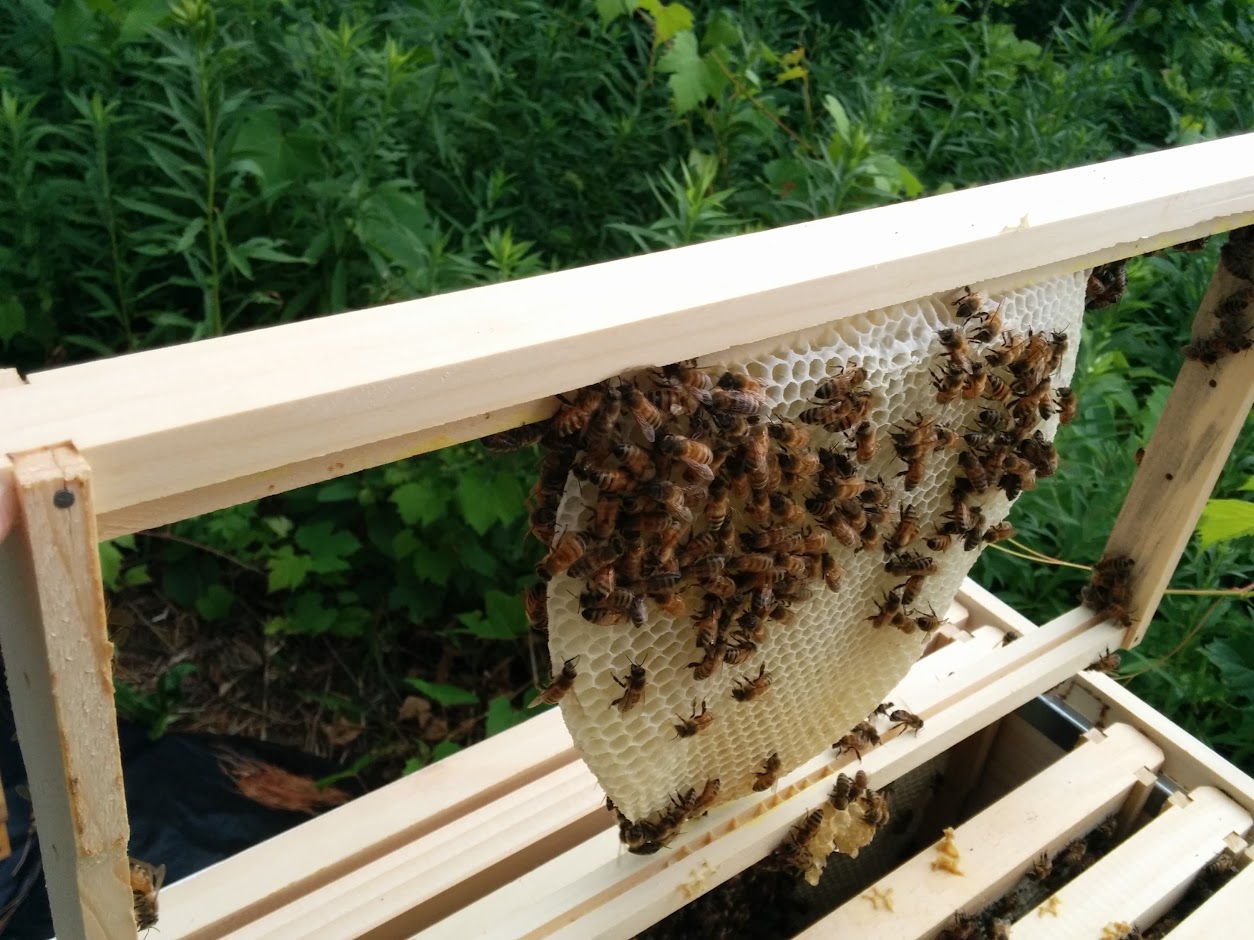
European Honey Bees
Notice the wax comb on the wooden frames


Bees, particularly honey bees, have been in the news often over the past few years, mainly due to their decline as a result of colony collapse disorder.

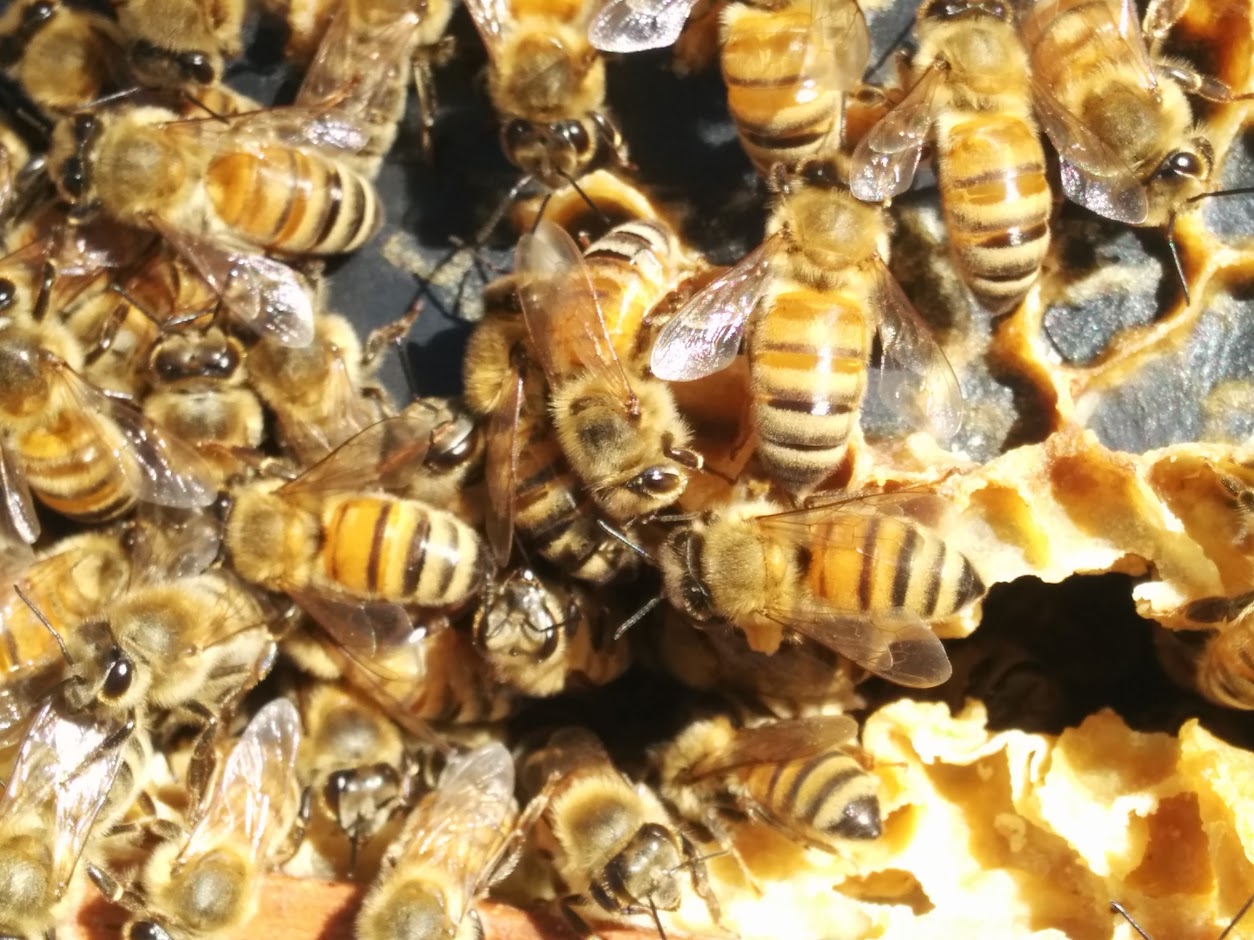
Honey Bee Workers
Honey Comb in the Making
Photo Credit: Gordon Fountain, 2016
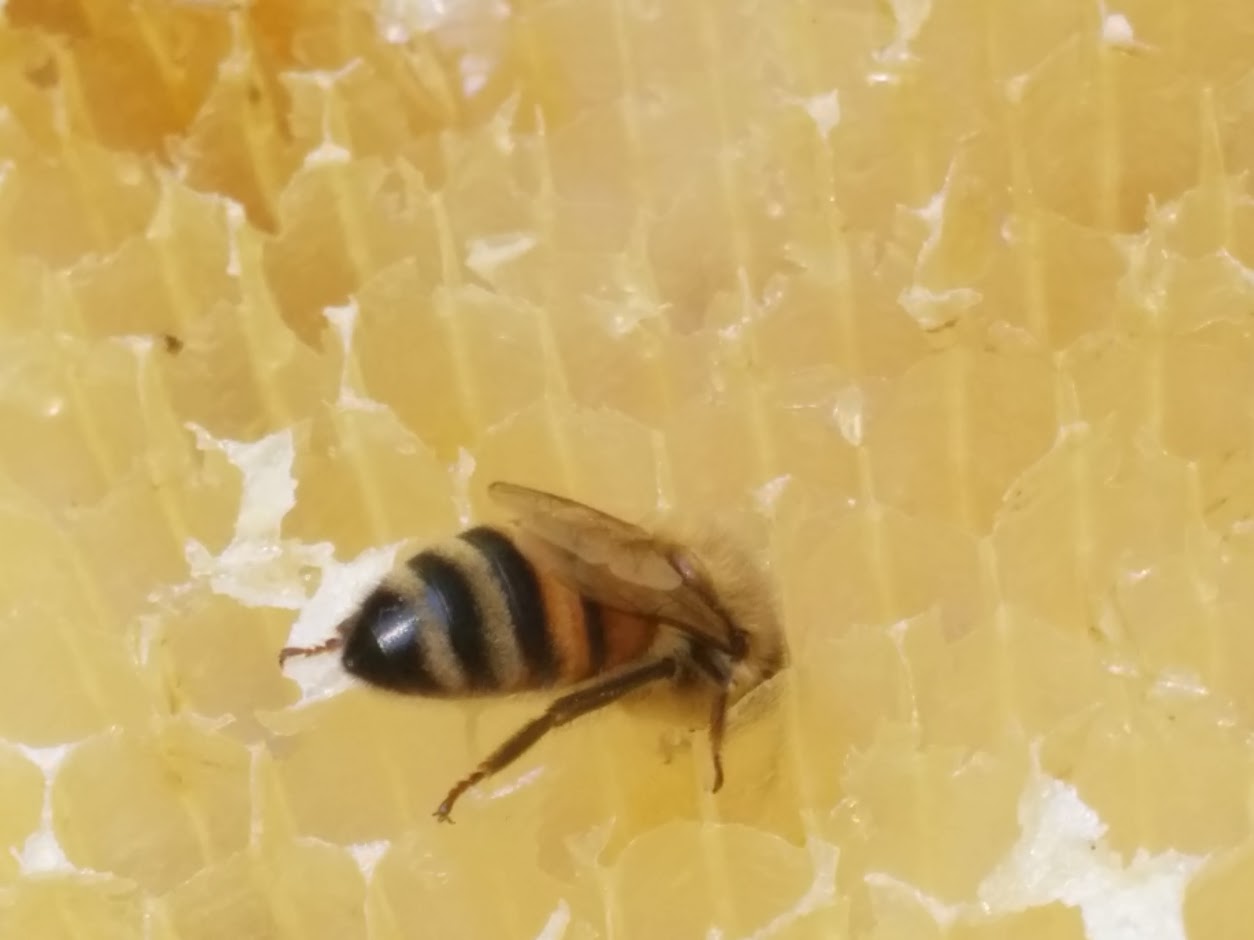
Worker Bee Filling Comb
Photo Credit: Gordon Fountain, 2016


Although honey bees are not native to North America, we have come to depend on them as important pollinators for a large portion of our crops. They are beneficial mainly for their pollination services, and more famously for their honey and wax.

Other bee species that are native to North America include bumble bees and many species of solitary bees. These are also important pollinators, although they do not live in hives the way honey bees do, and do not produce honey.
Common Bumble Bee
Large and "furry"
By Paul Stein from New Jersey, USA - Azalia Blossoms, CC BY-SA 2.0, https://commons.wikimedia.org/w/index.php?curid=51253464

Blue Orchard Bee
CC BY-SA 3.0, https://commons.wikimedia.org/w/index.php?curid=114919

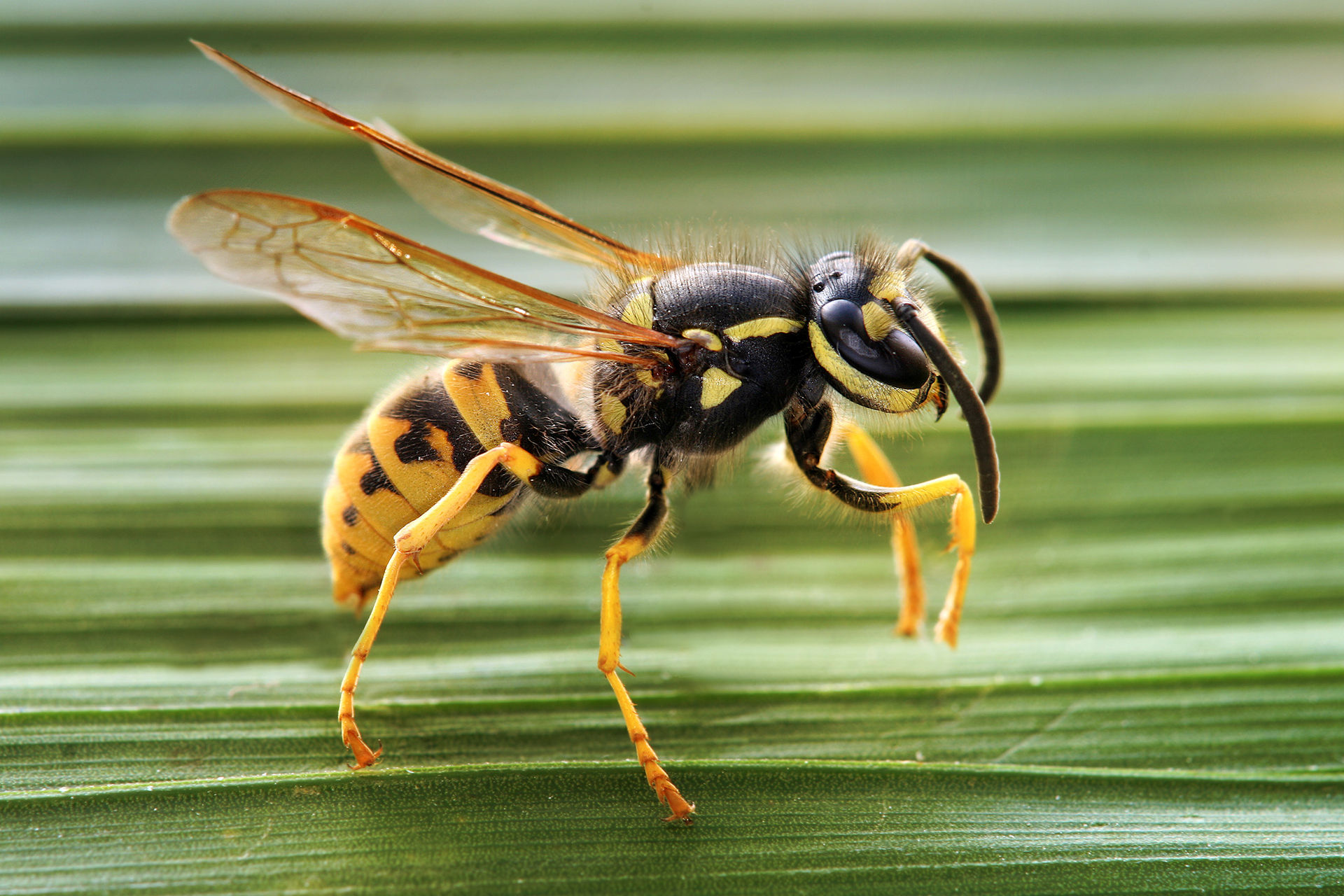
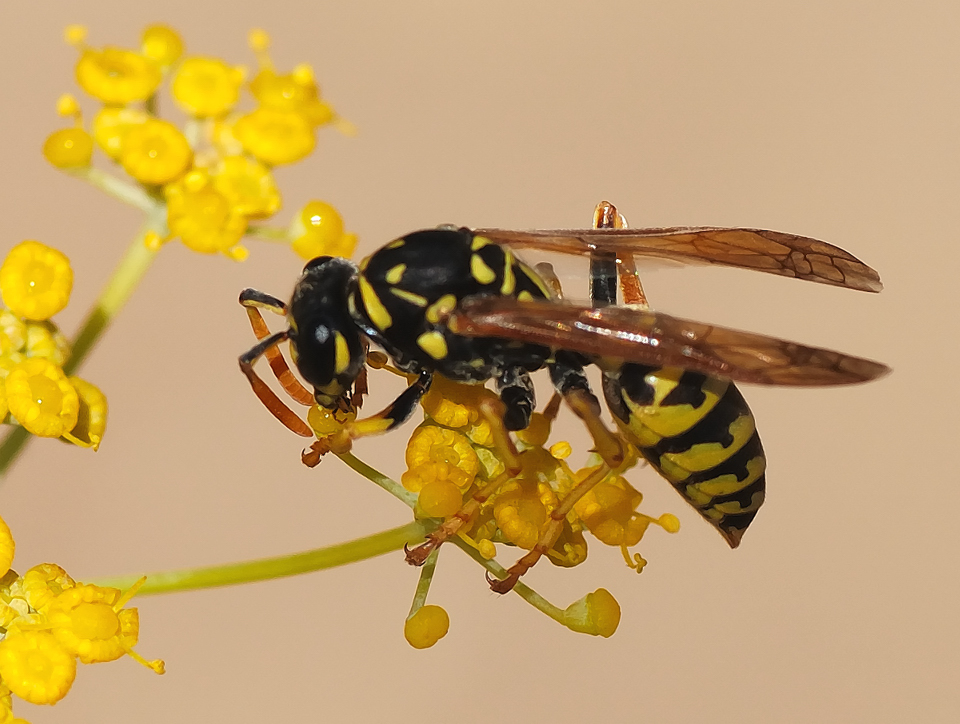
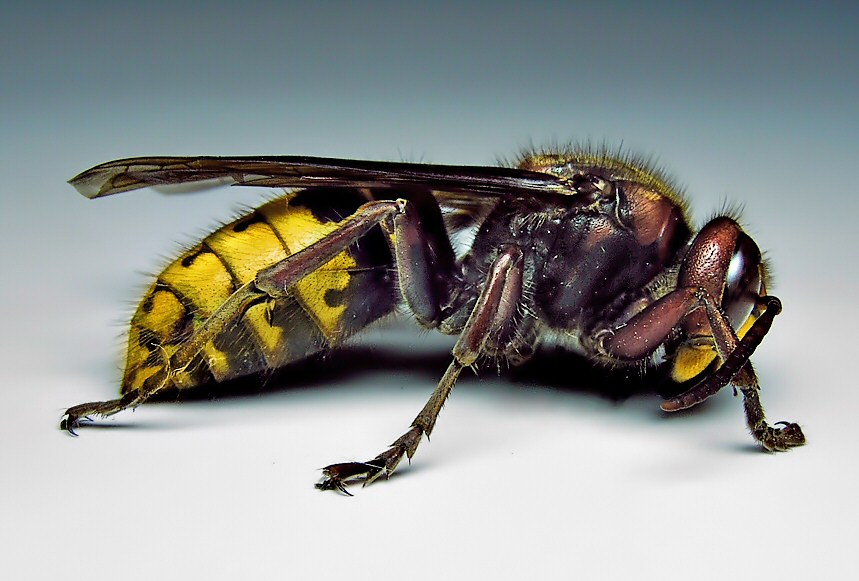
At this time of year, there is an abundance of wasps and hornets. These are not bees, but are often mistaken for them. They do not produce honey, are considered less effective than bees at pollination due to the lack of a hairy body, and are predatory. Among their prey are bees. They are aggressive, and are attracted to garbage bins, pop and fruit juices and any other sweet smells.

This is a Yellow Jacket WaspBy Richard Bartz, Munich aka Makro Freak - Own work, CC BY-SA 2.5, https://commons.wikimedia.org/w/index.php?curid=2577167
Wasp Building a Paper Nest
By Sanjay Acharya - self-made at Sunnyvale, California, USA, CC BY-SA 3.0, https://commons.wikimedia.org/w/index.php?curid=3952953

Notice that the body of the wasps are completely devoid of "fur" or hair. The connection between the thorax and the abdomen tends to be much thinner than in bees. The wings are elongated. Their legs have no pollen sacs.

Bees and wasps are also different in their behaviour. Since wasps are predators, they tend to be much more aggressive than bees. The exception is Africanized honey bees, which were introduced to North America in an effort to increase honey production, They are know for their aggression, but they also require a warmer climate than is found in Canada. Honey bees and other bees generally only sting when their safety or the safety of the hive is in question. Drones (male bees) cannot sting. If you are not opening up or tearing apart their hive, blocking their flight path to the hive or inadvertently crushing them, you are unlikely to be stung by a bee.

In the off chance you do get stung, the pain can be reduced by adding baking soda and/or crushed plantain (the common "weed", not the banana-like fruit) to the area. Watch for symptoms of anaphylaxis.

There is a small proportion of the population that is allergic to stings, and these stings could include hornet, wasp or bee stings. Learning to distinguish between these could become a matter of life and death for those affected.


Common PlantainBy Rasbak - Own work, CC BY-SA 3.0, 
https://commons.wikimedia.org/w/index.php?curid=210595

Friday, 1 July 2016

Feedback and Finals: The Problem with Culminating Tasks

In the field of education, one of the big buzzwords right now is "growth mindset". In essence, it asks students and teachers to visualize themselves on a learning journey in which mistakes can lead us to interesting places and new opportunities for learning; where a positive attitude is vital and reflection and improvement are key.

And yet, we still have final exams and unit tests.


Of course we can't spend forever on a specific topic, but to end the learning with a judgement activity that gives no feedback other than a mark does little to inform a student or contribute to further learning.

Perhaps I am still fixated on my high school's motto from many years ago, which was "Know the Reasons". I certainly live with that idea firmly implanted in much of what I do. However, it seems to me to be an important concept for continued learning, reflection and critical thinking which are sometimes found lacking in wider society (not to name any recent political campaigns or such, but I'm sure we can all find a real-life example in which critical thinking was found to be lacking).

So how can we approach summative assessment while encouraging students to continue to reflect on their understanding beyond "the test"?


Some teachers allow for re-tests, although this is becoming unpopular in some circles. Many teachers opt for summative projects rather than tests or exams. Some incorporate a self-evaluation into the culminating task. Are there other ways to approach this?

We've all seen it: student x gets back the test, looks at the mark at the top, then tosses it in the recycling bin never to be read or seen again. All of the notations and feedback on the paper are ignored, and an opportunity to learn from the assignment is lost.

This happens at all stages of a particular strand or unit, but is most common after the summative, perhaps because the student knows it will be a long time before they see that concept revisited. However, this is a valuable time in which to receive feedback because it is likely to address the student's highest level of understanding yet for this topic, skill or subject.

How do we get students to buy into such reflection?


The learning cycle is a lot like using a lint roller: every time you go over an area, a little
more stuff sticks. That also applies to reviewing all tasks. The mentality of "I'm so glad it's over, I never want to see x again!" is hard to overcome. Part of the issue may also be the idea that since the course has been passed (or not), the learning on that subject is no longer necessary or worth pursuing. When students see the report card or credit as the goal rather than the learning itself, the idea of review after the last task may seem pointless to them.

When students see the report card or credit as the goal rather than the learning itself, the idea of review after the last task may seem pointless to them.


Some schools have a period of time in which students can go over their final exam or assignment with the teacher. Other ideas might include a class discussion over the classes website, Facebook page or other online discussion venues, or a scheduled drop-in time where students can meet with their teachers. Some teachers build a reflection component into the final task itself. Although it can also be argued that a little more time and feedback could aid in reflection, taking time to do so at all is still a positive step.

I am curious about how students in classes wherein a growth mindset is strongly and embraced by the students might respond to such opportunities to receive more feedback and review/reflection when compared with classes who continue on a more traditional path. I welcome your insight in the comments below.


Sunday, 26 June 2016

Life with Bees


My son and I have become bee havers this spring. I use the word "havers" rather than "keepers" since the bees pretty much take care of themselves. We've only been doing this for a couple of weeks so far, but I've already learned much along the way. 

It's an interesting and calming activity to share with a kid who has always had a fascination with nature and small creatures.


Honey bees, for the most part, are docile and will only sting when the hive is under attack or they perceive it to be. There are Africanized honey bees that are more aggressive, but those only survive in warmer climates much further south than Canada. Our bees are a mixture of various European breeds that have been bred locally for several decades.

Honey bees are not native to North America, but since their introduction, they have become very important pollinators, and much of our food is the result of pollination of honey and other bee species. They may be known for their honey and wax, but their true importance to humans lies in their pollination abilities.

Many people mistakenly call wasps and hornets bees, but they are very distinct species with different habits.

Wasp
Wasp nest--not that it is paper, not wax
Above are a wasp and wasp nest. Note that the wasp's nest is paper-based, not made of wax, and that while it has hexagonal cells and rows of paper comb, the overall shape looks like a round paper lantern. Below is a picture of a hornet.
Hornet

Below are some honey bees on comb, and below them is a bumble bee.


Honey bees, on wax comb
Bumble bee
Wasps and hornets can be aggressive and most stings people receive come from these insects. Bees tend to be more docile, although they will defend their hives.

If you have bees on your property, do not use insecticides or call a pesticide company. Instead, contact your local beekeeping association and they will very happily remove the bees. Everyone wins as the beekeeper gets free bees and you get the safe removal without the use of toxic products.


Most honey bees are female. There is the queen, who is central to the hive and the only bee that reproduces in most cases (occasionally worker bees can become fertile, but can only lay unfertilized eggs which become drones). The queen is an egg-laying machine who depends on several workers to feed her.

The majority of bees in a hive are worker bees, who take on different roles during their short lives, including nurse bees who feed and care for larvae, foragers, builders of comb, defenders, etc. All worker bees are female.

A small number of bees are males, called drones. Drones are slightly larger than workers, have no stingers, and their only job is to mate with a distant queen. 

On our recent visit to the apiary (bee yard), we noticed that the bees at the entry were being groomed by other bees from the hive. This is an important activity as it helps the bees keep down the number of mites in the hive. Varroa mites are a serious threat to honey bees, but healthy hives are able to keep down their numbers through various activities, including grooming.

Some of the bees watched us as we took out frames for inspection to determine the health of the queen. I would guess that they were trying to determine if we were a threat to the brood. Since we moved slowly and carefully and did not threaten the hive, we became more of a curiosity than a threat.

Since these are new hives, it is important for us to know that the queen is healthy and laying new eggs. If she stops, the hive will need to build queen cells and start making a queen. They do this by choosing young larvae to feed royal jelly and bee bread, which is a mixture of pollen, honey and various enzymes. This feeding difference is the key to determining whether a bee will become a queen or a worker bee. Several queens are created. Upon emergence from the cell, the quickest and strongest one fights off the others to become queen of the hive.

Those who have not visited a bee hive may think this sounds absurd, but watching the bees go about their business has a very calming effect on people. It certainly does for me (and I was very hesitant about the whole idea not very long ago!).


Wednesday, 27 April 2016

Coding With Kids

Being able to write code is one way to move passive app and game users into more active learning. Writing your own code puts you in charge of choices and provides basic skill development that could become crucial as technology expands exponentially.

Coding also helps students learn to communicate clearly and with precision, and requires an attention to detail not found in many other areas of communication.

The Hour of Code movement promotes the exploration of code writing by students of all ages in order to introduce coding in an accessible manner. There are many Hour of Code activities that can be done with kids who have no experience with coding. Here is a quick sampler of some of the activities I've tried with my family:

https://scratch.mit.edu/ A family favourite, Scratch is an intuitive drag-and-drop building block style programming platform that helps introduce basic programming logic, yet can be used to create some surprisingly complex programs. It is accessible to even primary students, but provides enough challenge to retain relevance for older students as well. Be careful though, this one is very addictive!

https://code.org/mc Minecraft is a game, yes, but here you can use another drag-and-drop block based programming platform based on Javascript in order to create an adventure for Steve or Alex.

https://www.khanacademy.org/hourofcode Like many other aspects of Khan Academy, the activities here are somewhat more prescribed, but may suit learners who find an abundance of choice to be overwhelming.

https://code.org/learn Here you can find many more activities, apps and also "unplugged" coding activities for Hour of Code that require no electronics whatsoever
. We have tried Rock, Paper, Scissors and enjoyed it without the use of any devices.

http://ai2.appinventor.mit.edu/ For students with some coding experience, MIT's android app maker may be of interest. Students can work with their android device, or use an android emulator on a PC to run their programs.

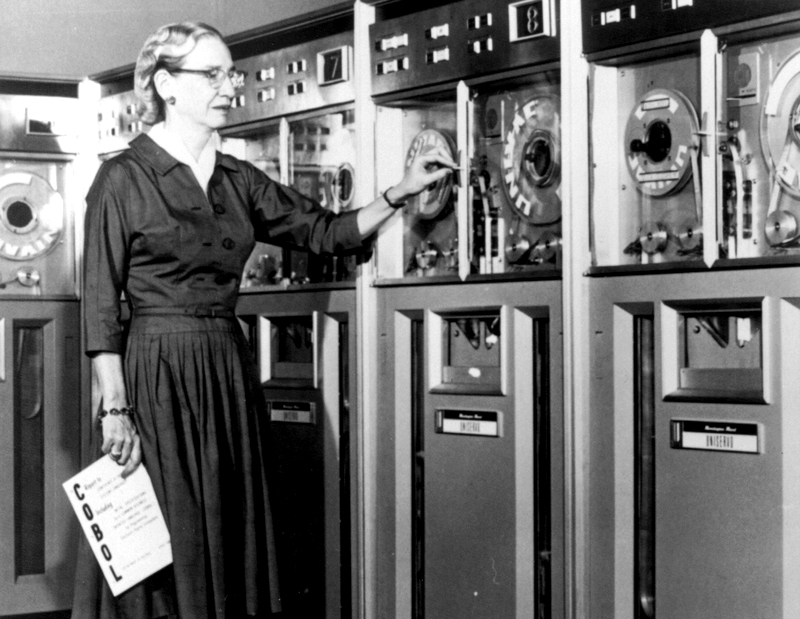
Grace Hopper, 1952


Where did it all come from?


Along with actual coding, the history of programming is also quite interesting.

In this clip from the 1970's Connections series with James Burke you can see how weaving looms led to punch cards which led to modern coding:

Much of modern coding was made possible by the early work of various female pioneers in the field. Grace Hopper create the first compiler, for example, which allowed binary input to be converted into a programming language.
The links below include interesting articles that highlight the contributions of women in the field, and also discuss how the demographic of the "typical programmer" changed over time:


Here is a blog post about how the act of knitting is closely related to coding:

The history and use of punch cards can be found here:

And for those who are particularly interested, here is an odd and long 1st-hand account of learning to program with punch cards in the 70's

Happy coding!

Wednesday, 13 April 2016

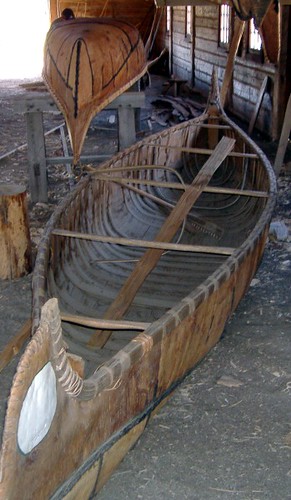
The Canoe Doesn't Care Who the Leader Is...

If it tips, everyone gets wet. 

~ as quoted by Ela Smith at the You Don't Know What You Don't Know Workshop series.


It's another way of saying "we're all in this together".

Most people are aware of the Truth and Reconciliation Commission Report and its 94 recommendations, but few Canadians are aware of the finer historical details leading up to it. Today I had the privilege of participating in the first two of three sessions aimed at educating professionals who work with children in my area.

I had thought I was relatively well-informed about the facts, but there was much that I learned today-- things that begin to help me make sense of why friends and students I have known have been reluctant to share their heritage.

When I was very young, the family that moved in next door to me had a daughter my age. We played together quite a bit. Her name was Marylee (or Merrilee? I was too young to worry about spelling at the time). There were several milkweed plants behind out houses, which shared a large unfenced yard, and we played with the sap and watched the monarch caterpillars and butterflies come and go together. We dug up worms together and watched them burrow back into the dirt. She tried to teach me how to climb a tree, and I brought out my dolls to play with her. I know it sounds cliche, but we really did make mud pies (and mud cakes, and mud pizzas) together. 
One day I heard my mom and grandmother talking about how that "Indian family next door from the reserve" had a problem with their son lighting fires around the neighbourhood, and after some deliberation, I was told I could play with Marylee, but not her older brother. Fair enough--who would want to play with a stinky older brother!

After we moved, I attended a new school and was instantly branded a troublemaker because during recess, I became very upset and agitated when the kids played "cowboys and Indians". The goal was to kill off the Indians! Marylee was an Indian! Why on earth would anyone want to kill her or her family?! Unfortunately, neither the other students nor the teacher on duty saw it my way.

We moved again, and soon after another family moved in beside us. It was a family with 4 kids. and the two girls were close to my age. We played together often, but I was a few months older than the eldest girl, and as result, I tended to become "the leader" in our play. I remember one day I crossed a line in my bossiness, and the girls went home and told their older brothers. They all came out and the brothers gave me a stern talking to. Being an only child, and having lots of toys, they saw me as spoiled. I saw them as a true family, united and strong, and I doubt they ever understood just how envious I was of them. I remember in that moment realizing that no toy I could ever own would ever match the bond they had as siblings, and it was perhaps one of the loneliest points in my childhood. I learned a couple of years after they moved in that their father was First Nations. I probably should have clued into this when they took me to Hagersville for ice cream and to visit to the uncle and grandfather on the reserve, but I was 8 at the time, so perhaps that is to be forgiven. The part I do remember is the way that whenever this came up in discussion, it was always spoken in hushed tones, very seriously, and very secretively. 

I grew up and became a teacher. More than once in my experience in teaching, I found out at the end of the year that a student of mine identified as First Nations. This was generally only revealed to me hesitantly or after knowing the student for several months, and still happens in this way even now. It saddens me that there is a silence and fear of revealing having such a rich and beautiful culture, and only after learning more, am I beginning to understand the role history has had in what can only be honestly described as cultural genocide. Generations of western immigrants and ignorant political and social policies and attitudes have made the original peoples of Canada become, in many ways, invisible and voiceless.

In Canada, in 2016, we have numerous communities without access to clean drinking water. We have housing issues, issues with mouldy, decaying schools and homes, high suicide rates, MMIW, and whole communities of students who have to face moving away from their homes and communities just to attend high school.

I did not know:
- about the "pass" system
- that there are 634 First Nations in Canada
- that homes on reserves are not eligible for mortgages and can only be purchased outright
- that "status" rules are in many ways discriminatory regarding gender
- that "status" "benefits" most often do not materialize--for example, although dentistry is supposed to be covered for status Indians, since the Federal government is less than punctual and reliable in paying for this, few dentists will honour it
- that not only were kids taken to residential schools and abused, but that they were often made the subjects of medical experimentation
- that kids were sent not to the closest residential school, but instead were sent an average of 6 hours away so that they would not be able to easily run away or see their families or communities
...and the list goes on.

Today, in discussing the history in more detail than I'd ever known before, and participating in the blanket activity developed by KAIROS, I am left reflecting on what I didn't know, what I still don't know, and my responsibility as a parent, teacher and Canadian to learn more in order to do my part in the reconciliation process. It took seven generations to get us here, and it will take seven to recover, and it is my responsibility and yours to help make that happen.


Wednesday, 23 March 2016

Pieces of the Whole

In working through activities for basic numeracy skills, the "pieces of the whole" idea keeps surfacing, regardless of what manipulatives or operations are being used. It started when I was looking through sock matching and sorting activities, in which two matched socks make a pair, with the "pair" representing a whole. It continued through Lego brick building, pattern block mosaics, and looking at everyday grid patterns such as are found in trays of cans, chocolate bars, golf balls, etc.

Whether you are working with addition and subtraction, multiplication and division, fractions or percentages, the concept of "part" forms a vital part of the math lesson.

Some examples:


In this chocolate bar, the whole is "5", so one piece is 1/5 of the whole. Fractions work when the size of the parts is the same for each piece. 
We can also share a single piece with 4 friends and have one left over to keep. 5 ÷ 1 = 5
We can break off two pieces to make the subtraction sentence: 5 - 2 = 3
and then add them together again to make the whole bar: 3 + 2 = 5


In this lasagne, there are 5 columns, of which one is missing. Therefore, 5 - 1 = 4, or, there are 4/5 of a lasagne left. We can also say that 20% of the lasagne has been eaten.


In this carton of eggs, there are 12 eggs. Two of the eggs are white, one is blue, and the rest are brown. 2/12 or 1/6 of the eggs are white. 1/12 is blue. 9/12 or 3/4 are brown.
2 + 1 + 9 = 12
We can also say there are 6 pairs of eggs, or 6 x 2 eggs in the carton.
If we only want to use the brown eggs, we can remove the others: 12 - 3 = 9
We can divide the carton by rows, columns, pairs of columns, or into two equal columns 3 eggs wide. In doing so, we can investigate factors of 12, and experiment with various potential common denominators when exploring related fractions, and explore equivalent fractions.

Parts of the whole form a basis from which we can build on many mathematical concepts. We can extend this for use when speaking of angles, while referring to the circle (360 degrees) as the "whole" from which other angles are compared. This is, in fact, exactly how pie charts work.


We can even take this into polynomials by calculating the area of a deck for a pool:
If the pool is 8 m x 15 m, what is the area of a deck that surrounds it if the width of the deck has a universal width of 4 m?
The pool and the deck together become the "whole" combining the area of the pool and the area of the surrounding deck. 

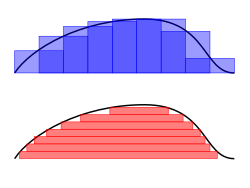
This concept, of parts making a whole, is also a vital part of integral calculus in which the area under an irregular curve is calculated.


Encouraging students to explore these concepts using mathematical terminology and sharing their discoveries can help in relating previous knowledge with new concepts.