Tuesday, 31 July 2012

Writing and Fine Motor Skills

Two generations ago, handwriting received great attention in the schools. Many hours would be spent creating a flowing cursive script akin to calligraphy. The handwriting of our grandparents was often like a work of art in its beauty. Many people mourn those days, but as a person who always struggled with both writing and typing, and the mother of a son with a fine-motor learning disability, I find the current availability of word processors and other writing tools to be a relief.

Audit4

Do we even need handwriting?

Actually, we do. The most important use of handwriting is one's signature. A signature is a wonderful thing. It is our own personal security code that we'll never forget. It need not be legible. It can be as decorative or plain as we desire. It is a symbol that has historically separated the illiterate from the literate, often with serious legal implications. In every aspect, it is a symbol of our own uniqueness.

Beyond the signature though, we do need our writing to be legible.

We need to be able to fill in forms, as many forms still cannot be filled in on computer. We need to be able to make quick lists and notes to others. Perhaps in the near future our smart phones and such will take over these tasks, but we're not completely there yet.

There are two main kinds of writing for the English language: manuscript (printing) and cursive. Since the type of most fonts falls into the manuscript category, and since traditionally this is what is taught and learned first, there are many people who advocate for its exclusive use. It is easier to read. Some people find it easier to write as they can concentrate on one letter at a time without worrying about the joinings. Many people can print almost as fast as they can write in cursive, assuming they have learned both systems.

But there is another population for which cursive may continue to meet a need. Students with fine motor disabilities may find cursive somewhat more accessible. When printing, the writer needs to position their pencil at the right place on the paper before starting each letter. To help new writers, some teachers use a ruler on the line below and/or show the writers how to space out words by placing a finger down at the end of a word to help them leave a "finger space" between the words. There is still a need to re-position the pencil after each and every letter. For those who fine motor issues, this can become a very onerous task. Add any visual perception difficulties (reversals, flips, "swimming words", etc.) and the task can become near impossible.

Cursive writing can help. When the need to re-position the pencil occurs less often, it becomes easier to complete a word. This doesn't mean the writing will become magically easier; cursive has its own challenges for these learners, such as planning ahead for coming letter placement, and remembering the high and low joining conventions. It can be like learning a new code for writing as it is becoming less common and students are less likely to be familiar with reading it. However, the trade-offs may be worth considering. Those who master cursive often find it faster than manuscript, but this may not be the case for everyone.

Fortunately, there are other options that help alleviate the physical demands of writing. There are adaptive keyboards designed to adjust for pressure, length of touch, etc.; regular word processing, speech to text programs, text to speech programs that allow students to hear their writing read back to them, and visual planning packages, such as Inspire. Each of these meets a different need and most programs offer a free 30-day trial to help you figure out what will best meet your needs.

It is important that students be able to express themselves well and often using whatever means works for them. These adaptations are not "crutches" but needed tools to enable them to continue to develop their communication skills. Slowing them down by forcing handwriting of any kind or even typing may cause them to write less and stunt their development. In such cases, it may be a good idea to separate fine-motor activities (handwriting, typing, drawing, etc.) from the communication activities (stories, poems, essays, reports, speeches, etc.) in order to allow students to continue to develop in both areas.

As homeschoolers, we have usually done things orally to compensate. In a classroom situation, this may not always be practical, but should be considered at least on occasion. Shyer students may need to do this one-on-one with a teacher or aide.

We are trying out various software options, and also working on developing finger strength and control, with the goal of improving legibility as well as increasing typing speed while using software to help with communication and academics in the meantime.

I'll let you know how it goes.


Friday, 22 June 2012

Geography Games

Photo source: NASA (posted on Wikimedia Commons)
If you follow my educational posts, you may have noticed that we play a lot of games. This is intentional. When children play, they explore and learn. Learning is natural and child-driven. Our adult agendas often serve to slow down learning, despite our good intentions of focusing on skills development. When we lighten up and embrace children's own natural ways of learning, we can become partners and guides.

Having said that, sometimes our society works such that kids need specific information at a specific time. Geographical knowledge is one example of this, although the subject might easily come up on its own after watching a documentary, trying out a new restaurant, or meeting a neighbour from a different land. Since most of us cannot afford to travel the world and explore many places in person, a few games may be in order.

For those of you who are hooked on integrated unit studies (I am, although my children do not like to learn this way), I have included some ideas for one at the bottom of this post.


Alphabet Geography

Needed:
either alphabet dice, such as those found in Boggle, or slips of paper each with a different letter of the alphabet kept in a container that can be shaken
a world map with location names (or a more detailed country, province etc. map depending on your intended focus)
note paper and pencils or laminated lined paper with wipe-off markers
optional: a timer

Choose a letter by rolling a dice or selecting a slip of paper. All players must write down as many place names as possible that start with that letter. When the time is up (3 minutes recommended), players check their answers against the map. If a player cannot show where one or more of their selections is located on the map, that selection does not count. Award a point for each correct place. Play for several rounds, over several days. The first game is the baseline. A player wins by gaining a higher score than their most recent game. Overall winners at the end of the series are those who have scored the highest cumulative amount, OR who have the highest final score, depending on the needs of the group.

Where In the World Am I?

Students use their understanding of cultural and physical features of places to aid teammates in figuring out their mystery location.

Needed:
Large and detailed World Map
various atlases, cultural, ecological, geological etc. references (library books can supplement your own)
a small pebble, bingo chip or similar
a timer (optional)

Students break into groups of 2-5 people per group. The first team decides who will be the first to travel. This person is blindfolded and must toss the marker onto the world map (which is to be lying spread-out on the floor or a large table). The teammates must spin the map as the traveler tosses so that there is no chance of the traveler knowing the general area it must have landed.
While still blindfolded, the traveler may ask yes/no questions about the culture, climate, ecology, terrain features, etc. of the place they are at. The goal is to figure out where they are in the least amount of time possible.
To make it more challenging: students must name a reference in literature, music, visual art, traditional clothing, or other art-related aspect of the country and must first use this to name the country or region before narrowing down the location any further with additional questions.
Alternatively, choose both a place and a time (you can toss a marker onto a timeline for this), and get some history happening here too!

Note: since the planet is 2/3 ocean, it is likely that a large number of tosses will land in the ocean. You can deal with these in several ways:
- if there is a nearby island, use this as the landing spot
- let the person guess until it is obvious they are in the ocean, and perhaps make it necessary to determine which ocean and whether it is tropical/temperate etc.
- have the person toss again until they hit land

Grocery Store Geography Study
BoroughMarketTomatoes

This field trip unit helps make connections between food, climate, ecology, farming and trade with extensions that include budgeting, cost, measurement, history, population distribution, and many other areas.

Organize a trip to a grocery store. 

For the first try at this, it is best to start in the produce section. Ask your students to choose at least five different types of produce to research. Now they find these in the produce section and record their country of origin. Be sure they double-check with any stickers or other labels right on the fruit, as the larger signs may not be accurate.

Back in the classroom or home, have the students make small labels of pictures of their produce and, using sticky tack, place them on the map according to the country from which they came. Repeat this at different times of year. When do apples come from nearby? Which produce is tropical? What kinds of produce could you grow where you live? What edible plants grow naturally in your area? What produce had to travel furthest to reach you?

Look up the climate of the various countries. Can you see a pattern in what grows best in each circumstance? Why don't bananas and mangoes grow in Canada? Why don't they make maple syrup in Africa?

Try this several times, visiting a local farm, a farmer's market, and/or an Indian, Chinese, Vietnamese, Jamaican, European etc. grocery store. What different produce was on offer? Where was it grown? Where do you think it originally grew? How does this affect the cooking styles of different cultures? What might be on the menu in a Chinese restaurant? Italian? Indian? African? Add as many different cultures and regions as possible.

For younger students, or as a first start of an extended unit:

Have a grocery store scavenger hunt. Divide students into small teams of 2-4 students. Distribute lists of items with different categories on them, such as tropical fruit, root vegetable, something from China, something grown close by, something with more than ten ingredients, something they think every student in the group would like, something with vitamin c, something that has protein, something that is a complex carbohydrate, something you can eat raw, something on sale, etc. Make sure students write or draw their answers rather than collect them, as the "put away" component isn't nearly as popular as the search! Also, do not make this time dependent, as this can encourage running and pushing in even very reserved students. If you suspect this might become an issue with your group, try staying all together and slowly walking through the store aisle by aisle together as they quietly and secretively note their finds.

Extensions:
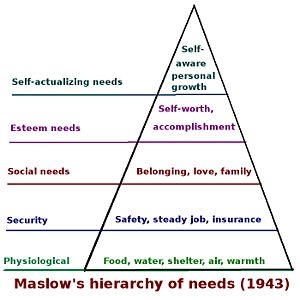
Maslow hierarchy of needsDiscuss what our basic needs are as human beings. Encourage students to brainstorm their own answers and share and discuss as a group. If you wish, you can introduce Maslow's Heirarchy of Needs (the link here is much more detailed than the image I have included). Once you have a basic list that the class has agreed upon, discuss how this might influence human settlement, both in the past and in the present. Refer to population maps and historical maps to see how accurate your predictions really were.

Integrated Unit Extensions:

Have students find a recipe and make a list of needed ingredients, then visit a grocery store to cost it out and, ideally, purchase the ingredients. You may give them some guidance here: it must be a type of salad, a soup, a type of cookie, etc., but then let the students decide on the details. Provide some strict budget guidelines. This is a great time to introduce the concept of cost per unit, both in terms of purchasing ingredients (encourage groups to share ingredients and pool their resources to buy in bulk), and also in figuring out the total cost per unit of their finished recipe compared with a prepared version of the same or similar item. Back at school, arrange for access to the staff room for groups of students to make/bake/cook their recipe. Share the food with the class at an end-of-unit potluck party. To include language arts, have the students create menus and/or write restaurant-style reviews after the party.
The skills used here include arithmetic, measuring (volume, temperature, currency, etc.), co-operation, negotiation, detailed planning, recipe research, reading for meaning, budgeting, sharing, and I'm sure there are many others I've forgotten! 

Planning Notes

To make the trip run smoothly and to ensure your continued welcome, ask the store manager when the least busy time is, and try and use this to schedule your trip. Group students into teams. Remind them that they are to be courteous and polite, refrain from running, and wait their turns. If your group needs extra support, be sure to enlist help from parents and other adults as needed. This could be an opportunity to discuss adult perceptions of children, how these may or may not be fair, and how their own behaviour could help influence these perceptions. Some kids may want to discuss ageism, so you may wish to ensure you give them enough time to discuss this very relevant issue.

Thursday, 7 June 2012

10 Great Ideas for Father's Day

No more ties!
Do you remember making endless construction paper ties for Father's Day as a kid? Are you stuck for an idea for something better, or at least different? You may want to try some of these. I've included five traditional gift ideas, and five of the "more memorable" variety. Enjoy!

Tried and True:

  1. Dad t-shirts and/or baseball caps: personalize these with hand prints, foot prints and other kid-style art
  2.  Dad mugs: you can custom decorate a ceramic mug using special ceramic paint (for the outside only)
  3.  Pencil & pen holders: you can make these from washed-out jars etc.; hot-glue on decorative features such as glass half-marbles, colourful rocks & gems, and/or use puffy paint to draw on details *these are more appropriate for dads who work in an office than, say, in construction 
  4.  Find a suitable photograph of child(ren) + dad & make a custom frame for it http://llemonade.com/gifts#frames
  5.  Make homemade soap-on-a-rope http://llemonade.com/gifts#soap rope

Less Traditional:


  1. Tie-dye a shirt, towel, etc. for dad http://www.llemonade.com/adultsci#dye
  2.  Make homemade ice cream for dad http://www.llemonade.com/ediblescience.html#labelf be sure to add lots of topping options to suit dad's preferences
  3.  Candy shirt: find an old shirt especially suited to the occasion; gather wrapped candy of varieties especially enjoyed by dad; hot glue these (on low temp. setting) to the shirt; give dad a running start before the kids give chase to grab the candies off the shirt Note: I take no responsibility for the results if you choose this activity! 
  4. Have the kids create a treasure hunt complete with clues etc. for dad; have a gift at the end, smaller gifts along the way, or you can have the end destination as the gift (restaurant, mini-putt, favourite fishing hole, etc.) Click here for tips on how to create a scavenger hunt
  5. Take our the old family photos & movies and put together a video specifically for dad; you can use Windows Movie Maker or try here for more Widows-based free software: http://savedelete.com/best-free-windows-video-editing-software.html Mac users can do a quick internet search for Mac software


Monday, 4 June 2012

Ask Your Teacher To Take You Outside

measuring claws
I have a t-shirt I wear often at this time of year. The front of it reads "Ask your teacher to take you outside today".

My oldest son attends a Sr. Public school, which means that there are only grade 7 and 8 classes there. In his first year, there was a grand total of one day of outdoor education. It was part of a science unit about food chains. On that day, the kids were piled into school buses and driven to a dedicated outdoor centre about 20 minutes away. It was a beautiful location, but the species we saw (I volunteered as a parent) could all be found within a 10-15 minute walk from the school. In grade 8, the was no trip; there was absolutely no outdoor education at all.

Now, this school has also won some environmental awards, mainly based on the efforts of a group of students to maximize recycling and composting during nutrition breaks. Some students have also worked to try and get some trees planted on the barren property, and others have suggested plans to build an outdoor classroom in the future. Would this classroom be used, were it to be built? Would demand slacken once the weather turned cold? What about kids who don't have adequate winter clothing, how could they take advantage of such an opportunity? Who would maintain it? How could it be used best?

Kids who play and learn outside tend to be calmer, more physically fit, and are less likely to be deficient in vitamin D.

When the teachers do not see the connections between nature and the subjects they teach, then they are unable to help the students make these connections. When the students rarely experience nature, they are not likely to make these connections on their own either.

In a world threatened by climate change, alarming rates of species loss, vast deforestation, explosive human population, ocean acidification, food security issues, and lack of clean water (more people have access to a cell phone than to a toilet), the lack of connection we have with nature is downright terrifying.

I could start quoting Richard Louv, but it would be much better if you were to read his books. The point I am making here is that our very educational system is missing one of the most crucial fields of study and our society is suffering as a result.

The sad fact is that children are better able to name brand logos than they are to name or in other ways identify plant and animal species found in their own back yard. Kids may go years without ever seeing any wild nature at all, let alone learn how to relate to it, understand it and learn from it. This reflects our obsession with things instead of life and place. Is this really the value system we want to pass on to our children?

I am fortunate to live in an urban area with easy access to natural areas. Yet the kids of neighbouring families still do not use these places, for reasons I can only guess at--safety, over-scheduling, or maybe because they fail to see the value in these places.

When we pare down our needs to the basics: food, clean water, clean air, shelter, and some might argue, companionship, it becomes clear that we are a part of the natural world. The rest is just static that we've created along the way. We are a busy, restless species, and this static can help us sometimes, but it is not a need, and it often gets in the way of our understanding of our place within the larger natural system.

dragonfly
Camping is a wonderful way to connect with nature. The less you bring along from home, the stronger your connection can be. Part of the trick is to relax and listen. Nature is not quiet, at least not in terms of actual sound; in fact it can be quite loud at times! But it has a rhythm and calmness to it that bring to it a different sort of qualitative "quietness" to it. Nature doesn't have "should's" or "ought to's" about it; it just is. For the keen observer, such as a child at play, there is much to be learned.

Do you remember that kid who never wore a coat when it was cold out, who spent more time outside than in, played outside even in the rain, and was daring enough to even sample the mud pies (you know, way back when kids actually used to make mud pies)? Do you remember how the adults used to say that he'd catch his death of cold etc., yet he never got sick? There are reasons for this that we are only now beginning to understand.

Last autumn my family and I went on a canoe trip down the Obabika River in Temagami (Ontario). This trip was a couple of days longer than our usual trip, there was rain through part of it, and a creek with what we called "quickmud" rather than water. We became wet, and slogged harder and further than on previous trips. When we returned home, we found the house unbearably warm, despite the fact that the thermostat read 18 C. During the trip our bodies had acclimatized to the weather without our noticing. This is something we don't often allow to happen, at least not in the western world, and yet it could be so very useful. I have to wonder, what other natural qualities have we lost along the way?

Thursday, 17 May 2012

Giftedness and Achievement: Attitudes, Misconceptions and Recommendations


What Does "Gifted" Actually Mean?

Part of the issue with identifying gifted students is that the criteria vary widely from place to place. Add to this the idea that permeates our society that gifted programs are somehow educationally superior to "regular" education, and a sense of elitism develops. In my opinion, groups such as Mensa do not help with this problem. Because of this, such programs are in high demand from parents who understandably want the best for their children. Different states and provinces face the need to look to a standardized test score criteria at which they can point to justify their programming decisions. Since different jurisdictions have varying levels of funding, student populations, resources, etc., the numbers are based on the perceived number of students they are able to serve. For example, many US states have a cutoff of a WISC IV score (one of the more common IQ tests) of 120; British Columbia has a cutoff in the low 130's. Other areas have different criteria again. Moving from one place to another doesn't change a learner's needs, but it may alter the services that are available.  When the learner is generally in the 120's range, the programs available in the US may well meet their needs. Placing a student with scores in the 160's in that same group will mean that either the teacher must be talented when it comes to providing differentiated instruction, or the needs of one or both extremes will not be well met.

Further complicating matters is the issue of potential cultural and linguistic bias in current measurement tools. While the tools are generally deemed statistically reliable, they are norm referenced on an "average" population which may differ substantially from the background of a student who comes from a different area and/or has a different first language or culture.

Another issue that often goes unaddressed is that of achievement vs. potential. For various reasons, many gifted students do not perform to their potential. When teachers are not trained to look for signs of giftedness, these students may be overlooked.

Gifted students may well be the stereotypical ones with their hand up to answer questions, their work completed perfectly and handed in on time, and who achieve straight A's on their report cards. It is just as likely though that the students who accomplish these things are high-achieving bright students who are not, in fact, gifted. The kid who spends hours on the bench by the principal's office, or the one who hides in the back of the classroom may be gifted. The little girl who comes to the breakfast program wearing hand-me-down pants with holes in the knees may be gifted too. So might the child who speaks no English and recently arrived to the school without any transcripts or files.

Overachieving is commendable, provided the child is happy and well-rounded, but it is not the same thing as being gifted. Overachievers who are grouped with gifted learners may suffer because their needs are much different.

I am going to say this once: not all children are gifted. All children have their own unique strengths and talents, and all children are valuable, but this is not the same thing as being gifted.

Being gifted is not a value statement. A person's worth is not measured purely by academic potential. Individual learners have the right to progress at their own pace, to learn in their own unique way, and to be challenged at a level that matches their own needs.

Gifted students face challenges that are not often understood by others.

Since learning often (but not always) comes easier for these students, it is not unusual to find students who have reached the post-secondary level who have never had to study for a midterm, have minimal note taking skills and suffer from an inability to properly organize and manage their time. Up until then, simply listening in class and occasionally flipping through the textbook may have been enough. Writing an assignment the night before it was due may have worked for them while in high school.
Since these skills were not essential, they were not learned and need to be learned if the student is to progress in higher education.

Now I'm going to backtrack a little. There are gifted students whose abilities are not necessarily in the academic realm. They may be gifted in the arts, leadership or sports. These students also have unique needs which must be addressed.

Because gifted students are more likely to understand complex social issues at a young age, they may have worries and nightmares that are difficult to manage. How do you explain away the famine in East Africa to a four year old in the wee hours of the night? You can try and shield him or her from the news, but it just takes a simple trip to the grocery store or library and the child has read the headlines (or full articles) and demands to know more. Gifted children tend to be keen observers; one way or another they are going to learn about these things, and probably at an earlier age than we would like.

It is important to understand that gifted 6 (8, 11, etc.) year-olds are still 6 year-olds. They may understand complex issues, but they are physically and emotionally still 6 years old. When an adult reads about these things and feels powerless, it is one thing, but when a young child reads it, that sense of powerlessness is magnified. These children may not understand why their friends do not share their concerns. This puts a strain on social relationships from an early age. People react differently to children who are exceptional, and gifted children feel this too. Responses may range from defensiveness to amazement and everything in between. No one likes to be a circus act or be told "Well, if you're so smart...", but the sad reality is that this is often a part of the package for gifted children.

Gifted children usually understand that they are different from most others from an early age. Depending on their personalities and experiences, they may react in different ways. They may retreat and pretend to be "normal", they may develop a fear of success (if I succeed, I or others will expect much more from me), a fear of failure (if I fail, then I wasn't really so smart after all), perfectionism, and / or depression. Less often, they may gloat and gain a superiority complex over their peers. Some try and hide their abilities, and some rebel. Psychological testing can help identify students who have built up their defenses and allow them to gain access to professionals and programs that can help them learn necessary coping skills in order to lead a fulfilling life. It can also help identify (or dispel incorrect diagnoses of) other issues, such as learning disabilities, ADD/ADHD, etc.

It is a myth that all gifted students move on to higher education and fantastic careers. The attitude that "the cream will rise to the top" doesn't work for many; sometimes the cream sours, and sometimes the homogenized nature of society and especially our education system grinds them down, and many fail to live to their potential. I want to clarify here that by "potential" I mean the potential for a happy, fulfilling life, not the number of letters after the name or the dollar figure in their bank accounts. In fact, many gifted students fail to complete high school, and many suffer from depression, bipolar disorder, or other related illnesses.

A well-designed gifted education isn't just something extra fun and exciting, with lots of academic prestige and opportunities for a special elite population. It can be a lifeline for some students.

Ideally, gifted programming should include coping mechanisms for dealing with these issues with peers and adults. It should teach students to understand how their brain functions and how they are both "the same" and "different" from others, why this is, and how this works for people with a variety of exceptionalities. Along with basic study skills and time management, it should include academic enhancement, enrichment and acceleration according to the individual needs of each learner. It should provide opportunities to work in the larger community both within the school and outside on various academic and community service projects. It should allow space and support for student-led inquiry. Like all education, it should help to develop the whole person, academically, socially, spiritually and emotionally.

The needs of the gifted are unique and in order to serve such students, we need teachers and administrators who understand these needs and have the necessary skills and training to serve this population.